This free step-by-step tutorial will teach you everything you need to know about subtractingfractions with differentdenominators. By using a simple 3-step strategy and working through several practice problems together, you will learn how to subtractfractions with unlike denominators with ease.
HowDoYouSubtractFractionswithDifferentDenominators? Note: Subtractingfractions with unlike denominators doesn't have to be a nightmare. Just find a common denominator and everything calms down! See how to keep your fraction subtraction calm with this tutorial.
Next, multiply the first denominator with the second numerator and subtract the second product from the first product to find the numerator of the resulting fractions.
Step 1: Change the unlike fractions into like fractions by finding the LCM of the denominators. Step 2: Subtract the new numerators and write them as the resulting numerator.
Below we will provide you with a four-step approach and several tips that help you solve fractionsubtractions easily. Learn more: Numerical Reasoning Tests Guide. The four-step approach is a traditional method that is applicable to all cases, regardless of the fraction types you’ll be dealing with.
The main rule of this game is that we can't do anything until the denominators are the same! We need to find something called the least common denominator (LCD)... It's really just the LCM of our denominators, 2 and 3. The LCM of 2 and 3 is 6. So, our LCD 6. We need to make this our new denominator... Change the : Change the : Now we can do it!
Rewrite each fraction to its equivalent fraction with a denominator equal to the LCM = 30, then subtract their numerators. Make sure to reduce your answer to the lowest term.
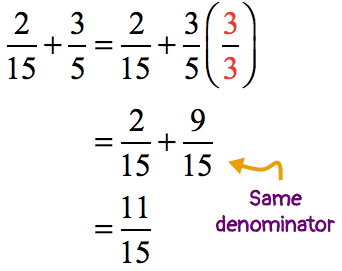
In this guide, we’ll use addition examples to show you exactly how to handle fractions with unlikedenominators. Plus, you can download our free printable worksheets to help your child practice and build confidence at home.
By now in this chapter, you have practiced multiplying, dividing, adding, and subtractingfractions. The following table summarizes these four fraction operations.
 Rewrite each fraction to its equivalent fraction with a denominator equal to the LCM = 30, then subtract their numerators. Make sure to reduce your answer to the lowest term.